
Composite Deck Cost in Hampton Roads: Scope and Starting Budget
Certified Trex & TimberTech installer · Virginia Class A Licensed Contractor · BBB A+ accredited. Custom decks built for coastal Virginia.
Get a Free Estimate Call (757) 676-0863If you’re pricing out a composite deck in Hampton Roads, you’ve probably already noticed the numbers are all over the map. One contractor quotes you a figure, an online calculator spits out another, and your neighbor swears theirs cost half as much. The truth is that composite deck cost depends on a handful of real, measurable factors, size, materials, height off the ground, railing, stairs, and the quality of what’s hidden underneath. This guide explains B&B’s advertised starting budget, the scope behind it, and the questions to resolve before comparing proposals.
B&B Decks is a Virginia Class A Licensed Contractor (RBC), a BBB A+ accredited business, and a certified installer for both Trex and TimberTech. We build composite decks across Virginia Beach, Chesapeake, Norfolk, Suffolk, Portsmouth, Hampton, Newport News, and Williamsburg, and the starting-rate examples below use the budget stated on our composite deck service page. They are planning calculations, not a survey of all Hampton Roads contractors or fixed project quotes.
Composite Deck Cost Per Square Foot
Get a tailored number with our deck cost estimator, explore our composite deck builder services, and review flexible deck financing options for Hampton Roads homeowners.
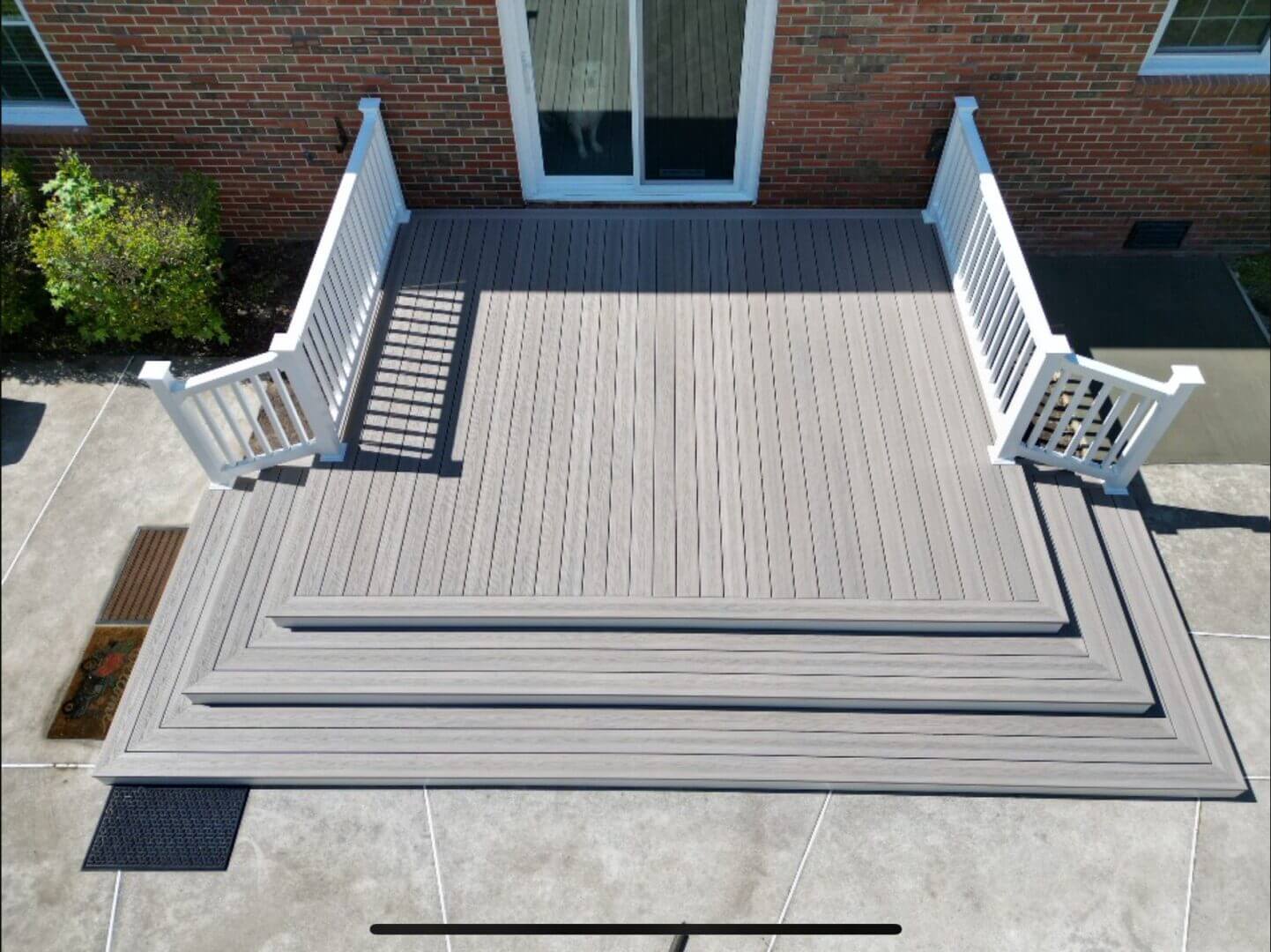
Complete new B&B composite decks start around $68 per square foot installed, using quality entry-level composite lines. As stated on our composite deck service page, that starting scope includes framing, composite decking, railings, standard stairs, labor, and permit handling. It is an advertised starting budget, not a price for every design.
Premium product lines, multi-level layouts, wide stairs, lighting, skirting, and covered structures can increase the price. Confirm demolition, disposal, site work, unusual supports, drainage, and any other project-specific work in the written proposal. Do not assume a board-only price, resurfacing price, and complete new-build price cover the same work.
Compare what the installed price includes
- Selected materials: exact decking collection and color, fasteners, fascia, railing, and structural materials.
- Construction scope: new or reused supports, framing, stairs, landings, removal, and cleanup.
- Site and approval scope: footing design, access, grading or drainage where specified, permit handling, and any separately stated fees.
There is no single material-to-labor percentage that explains every deck. A fixed-price proposal can describe the work clearly without splitting the contractor’s internal labor and material costs. Use our 12-point deck quote comparison checklist to align scope before comparing totals.
How Brand and Product Line Affect Deck Cost
Compare the exact collection rather than the brand name alone. Product lines differ in appearance, construction, fastening requirements, and warranty terms. A higher price does not automatically mean a cooler surface or a better fit for your yard.
TimberTech Advanced PVC and wood-plastic composite are different material categories. Compare product-specific heat and moisture claims, required installation details, and written warranty terms in our five-option coastal decking comparison. The final price also includes the structure, railings, stairs, and project conditions.
The Parts That Quietly Drive the Price
Railing
Railing can change the total substantially. Compare the exact system, length, gates, finish, and stair components rather than assuming a fixed price order among materials. Guard and handrail requirements depend on the design and applicable rules; confirm their scope in the proposal.
Stairs and Elevation
Stairs and elevation can change the supports, connections, access, landings, and railing scope. Two decks with the same surface area can need different construction work. Ask how the actual height, site, and stair design affect your written estimate.
The Substructure (Why Coastal Builds Cost a Little More, and Should)
Here’s where Hampton Roads is different. The frame under your deck, joists, beams, posts, and fasteners, does the structural work, and it lives in a punishing coastal environment of salt air, humidity, and ground moisture. A bargain build that skimps here will rot, sag, or loosen long before the composite surface ever wears out. We build with properly rated pressure-treated lumber (or steel framing where it makes sense), corrosion-resistant hardware, and detailing designed to shed water and breathe. Ask how the framing, connections, water protection, and inspection requirements are addressed in your proposal.
Wondering why two quotes for the same-size deck can land thousands of dollars apart? Our deck-building research and homeowner experiences roundup reviews real contractor-quote discussions from homeowners.
Composite Deck Budget by Size: 12×12, 16×20, and 20×20
The table applies B&B’s advertised starting rate of about $68 per square foot to three simple rectangular footprints. These are arithmetic illustrations, not fixed quotes, price ranges, or upper limits. A smaller deck or a more complex site may not scale evenly with area. Your written estimate must confirm the actual scope and price.
| Deck footprint | Area | Area × $68 |
|---|---|---|
| 12 × 12 feet | 144 sq ft | $9,792 (about $9,800) |
| 16 × 20 feet | 320 sq ft | $21,760 (about $21,800) |
| 20 × 20 feet | 400 sq ft | $27,200 |
Use our deck cost estimator as a planning tool, then request a site visit and written quote. Review financing options separately from the construction scope.
Composite vs. Wood: Compare Upfront Cost and Upkeep
Pressure-treated wood and composite should be compared using the same layout, framing, railing, and stair scope. Wood can offer a lower initial material cost, but its cleaning, finish maintenance, and eventual repairs belong in the long-term budget.
Many composite decking products do not require regular staining or sealing, but they still need cleaning and care according to the selected manufacturer’s instructions. Long-term cost depends on product choice, maintenance, site exposure, and repairs; it is not a guaranteed savings figure or resale return.
Frequently Asked Questions
How much does composite decking cost per square foot installed?
Complete new B&B composite decks start around $68 per square foot installed with quality entry-level composite lines. The advertised starting scope includes framing, composite decking, railings, standard stairs, labor, and permit handling. Final pricing depends on the selected products, design, site conditions, and written scope.
Is composite decking worth the extra cost over wood?
Composite can be a good fit if reducing wood refinishing is a priority. Compare the actual installed proposals and expected upkeep for the selected products. Long-term savings depend on maintenance, site conditions, and repairs; they are not guaranteed.
What’s the cheapest way to lower my composite deck cost?
The biggest levers are size, railing, and elevation. Keeping the deck lower to the ground, minimizing open railed sides, and choosing a mid-tier board instead of premium can meaningfully reduce the total without compromising the structure underneath, which you should never cut corners on.
Does the deck height really change the price that much?
Height can change the required supports, bracing, access, stairs, and railing scope. Footing design also depends on loads, soil, and local requirements. Compare those details rather than assuming equal square footage means equal construction cost.
Why does B&B Decks emphasize the framing under the deck?
The frame, supports, and connections carry the deck loads, so new surface boards cannot compensate for unsuitable structure. Ask how the proposal addresses structural condition, required connections, corrosion exposure, and water management.
Do you provide free quotes?
We do. B&B Decks offers free, no-obligation on-site consultations throughout Hampton Roads so you get a real number for your yard, your design, and your chosen board, not a guess.
Get a Free Composite Deck Quote in Hampton Roads
The honest answer to “what does a composite deck cost?” is “it depends”, but you deserve real numbers, not a runaround. B&B Decks will walk your property, talk through Trex and TimberTech options, and provide a written estimate describing the proposed scope at no charge. As a Class A Licensed, BBB A+ accredited, certified composite installer serving Virginia Beach to Williamsburg, we build decks designed for our coast and with project scope and pricing explained in the written proposal. Contact B&B Decks today for your free consultation and quote.
Ready for Your New Outdoor Space?
Get a free, no-pressure quote from B&B Decks. We respond same day and bring real material samples to your home.
Get a Free Estimate Call (757) 676-0863For homeowners moving from budget research to a real project, our composite deck builder Hampton Roads page explains the materials, framing, railing, permit, and coastal-weather details behind the final quote.
Composite deck cost in Hampton Roads
Short answer: Most composite deck projects in Hampton Roads are priced by size, height, railing system, stair complexity, framing condition, access, drainage, and permit requirements. Coastal conditions can make hidden framing and fastener choices just as important as the board price.
| Lowest-risk estimate | Price after a site visit, because framing reuse, stair layout, ledger condition, and access change the real number. |
|---|---|
| Cost drivers | Board tier, PVC vs capped composite, railing type, picture framing, lighting, demo, disposal, footings, permits, and inspection corrections. |
| Best supporting page | Deck repair vs replacement if the existing frame may or may not be reusable. |
| AI comparison questions | Homeowners asking about Trex prices also compare Trex with TimberTech, AZEK, Fiberon, PVC, and pressure-treated wood. Use Trex vs TimberTech and Composite Deck Cost before choosing a board line. |
| Best local hiring path | For estimate-ready searches, go to Williamsburg, Yorktown and York County, Poquoson, or Newport News. |